



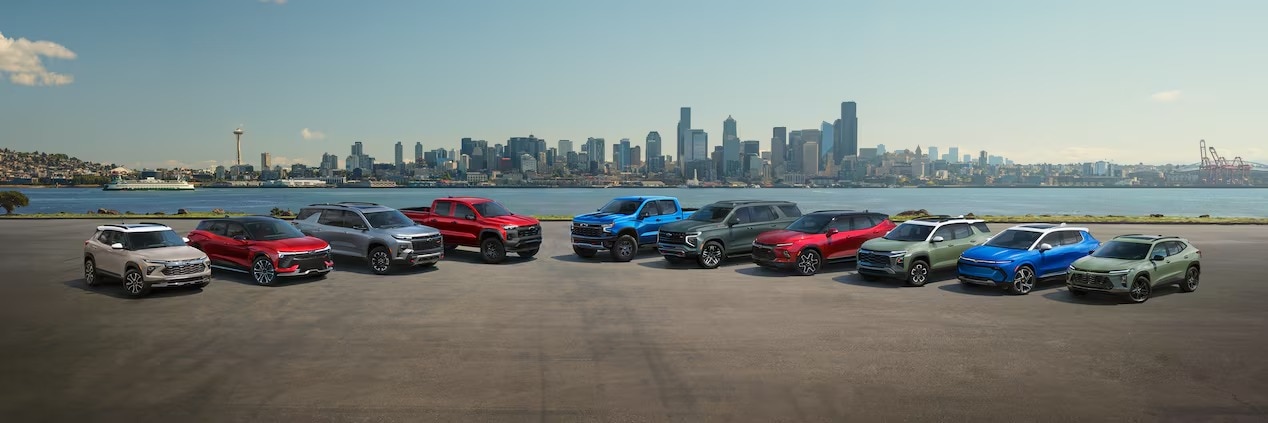
- Chevrolet and GMC both belong to General Motors, but they serve different types of truck and SUV shoppers.
- Many Chevy and GMC trucks share platforms, engines, towing ratings, and warranty coverage.
- For many Victorville buyers, Chevrolet offers strong capability and long-term value without the GMC price premium.
Spend enough time on a car lot or in an online forum, and this question will come up eventually: are GMC and Chevy the same? The short answer is no. But the longer answer is actually more interesting. These two brands share far more than most buyers realize, yet they're built to serve genuinely different purposes. If you're shopping for a truck or SUV in the High Desert and trying to figure out which way to go, it's worth understanding what actually separates them.
The Short Answer: Same Family, Different Personalities
Both Chevrolet and GMC fall under the General Motors umbrella, so yes, at the corporate level they're the same company. General Motors makes Chevy. It also makes GMC. So when people ask, "Is Chevy considered GM?" the answer is absolutely yes. Being part of the same parent company doesn't make them identical brands, though. Think of it like two siblings from the same household who turned out pretty different.
Chevrolet is GM's high-volume, broadly accessible brand. It covers everything from economy cars to performance vehicles to heavy-duty work trucks. GMC stays focused almost entirely on trucks and SUVs, leaning into a more premium, polished image. That's really the heart of the difference between GMC and Chevrolet: one casts a wide net, the other plays a more targeted role in the market. If you're already leaning toward a truck, take a look at our Silverado lineup and see what Chevrolet brings to the table.
How Chevrolet and GMC Both Fit Under the GM Umbrella
General Motors has used a brand-segmentation strategy for decades, and keeping both Chevrolet and GMC under one roof is a deliberate business decision. Rather than competing against outside manufacturers at every price point, GM competes with itself across different buyer preferences. This is essentially why GMC and Chevy are separate brands despite sharing so much behind the scenes.
Chevrolet handles the volume end of the business, moving a massive number of vehicles across a wide spectrum of buyers. GMC fills a more focused niche, appealing to people who want a truck or SUV but prefer a slightly elevated presentation. The strategy works because the two brands don't truly undercut each other. They attract buyers at different moments in the decision-making process, and at different points in their financial comfort zone.
What Chevrolet and GMC Actually Share
Here's where things get interesting, especially for anyone who's wondered whether GMC and Chevy parts are the same. In many cases, they essentially are. The 2026 Silverado 1500 and Sierra 1500 are built on the same platform and share identical powertrain options: a 2.7L TurboMax four-cylinder, a 5.3L V8, a 6.2L V8 producing 420 horsepower, and a 3.0L Duramax diesel. Both pair with a 10-speed automatic across most configurations (the base TurboMax uses an 8-speed), and both offer 4WD systems. Maximum towing reaches 13,300 lbs when properly equipped on either truck.
The shared engineering extends to safety tech and warranty coverage. Both trucks include automatic emergency braking as a standard feature, though blind-spot monitoring is reserved for higher trim levels. Both carry identical warranty terms: 3-year/36,000-mile bumper-to-bumper and 5-year/60,000-mile powertrain coverage on gas engines. That's not a coincidence. It reflects the fact that these two trucks draw from the same engineering and manufacturing foundation.
For Chevrolet buyers, that's genuinely good news. You're getting the same R&D investment, the same testing cycles, and the same reliability that has made GM trucks some of the best-selling vehicles in the country.
Where the Two Brands Genuinely Differ
The mechanical foundation is largely shared, but the brands diverge in meaningful ways once you move past the frame and drivetrain. Those differences show up most clearly in styling, interior packaging, and trim structure.
Exterior Styling and Design Philosophy
GMC vehicles lean toward a bolder, more assertive look. Chrome trim appears more liberally, body lines tend to be sharper, and the overall aesthetic signals a premium product. The Sierra has a distinctly upscale front end compared to the Silverado, even though the two trucks are structurally near-identical.
Chevrolet's design philosophy is more varied and, in many ways, more practical. The Silverado looks tough and capable without trying to look expensive, which isn't a criticism at all. For buyers using their truck as a genuine work vehicle, that straightforward utility styling is exactly the point. The design difference between GMC and Chevrolet trucks is less about quality and more about intent.
Interior Packaging and Feature Availability
Step inside a fully loaded GMC Denali and you'll find soft-touch materials, wood and metal accent trim, and premium technology stacked in at every level. GMC has invested heavily in making its interiors feel like a step above the segment average, and the Denali delivers on that positioning.
Chevrolet counters with a wider range of trim levels that let buyers choose exactly how much interior refinement they want. The Silverado 1500 offers nine trim levels, starting at the Work Truck and scaling up through the LT, LTZ, and High Country. The Sierra 1500 offers eight trims, beginning with the Pro. At the top of the Chevrolet lineup, the High Country delivers a sophisticated cabin that competes directly with anything GMC offers. What Chevrolet does particularly well is giving buyers the ability to scale features up or down based on what they actually need, rather than paying for a premium baseline across the board.
Both trucks also offer multi-function tailgate options. Chevrolet's is called the Multi-Flex tailgate; GMC's version is the MultiPro. The mechanics are similar, though each brand has its own implementation and branding.
Pricing, Value, and What You Get for the Money
Is GMC more expensive than Chevy? Yes, generally. And the natural follow-up question is whether that extra cost is actually justified. GMC trucks and SUVs typically carry a price premium over their Chevrolet counterparts, even when the mechanical content is essentially the same.
That premium reflects branding and presentation more than engineering substance. For buyers who value that, it makes sense. For buyers who care more about capability, reliability, and getting the most truck for their money, the math often favors Chevrolet. Here's a quick comparison of the key points:
| Aspect | Chevrolet Silverado 1500 | GMC Sierra 1500 |
|---|---|---|
| Trim Levels | 9 options (starts at Work Truck) | 8 options (starts at Pro) |
| Max Towing | 13,300 lbs | 13,300 lbs |
| Top Trim | High Country | Denali |
| Tailgate | Multi-Flex | MultiPro |
| Brand Focus | Value and capability | Premium positioning |
Is GMC Really More Premium Than Chevy? Let's Be Honest
The idea that GMC is meaningfully nicer than Chevy is partly a marketing achievement and partly a real product difference. At the top of each brand's lineup, the gap is noticeable. The Denali's soft-touch materials and distinctive styling do set it apart visually from the High Country. But performance, towing capacity, and warranty terms are identical. When both trucks max out at 13,300 lbs of towing, share the same 6.2L V8, and carry the same 5-year/60,000-mile powertrain warranty, the capability gap simply doesn't exist.
In the middle of the market, where most buyers actually shop, the difference between GMC and Chevy trucks is far less dramatic than the price gap implies. Whether Chevrolet or GMC is "better" comes down less to objective quality and more to what you personally value in a truck. For most practical buyers, that honest perspective is worth keeping in mind when sticker prices start to diverge.
Why Chevrolet Is the Smarter Choice for Most Victorville Buyers
For buyers in the High Desert, Chevrolet makes sense on multiple levels. The Silverado handles work use, family use, and weekend hauling without asking you to pay a premium for a badge. Whether you're towing a trailer on the 15 or loading up for a trip into the mountains, nine trim levels mean you can enter the lineup at a reasonable price point and add features as your budget allows. The SUV lineup, including the Tahoe, Suburban, and Traverse, gives families in communities like Victorville versatile, well-rounded options that fit actual day-to-day life.
Because Chevy and GMC trucks share core mechanical components, you're getting the same reliable hardware at better value. For long-term ownership, genuine OEM parts, factory-certified service, and a wide network of technicians familiar with the platform make Chevrolet straightforward to own and maintain. That practical advantage shows up over years of driving, not just on the day you sign the papers.
We also carry Chevy EV inventory for buyers exploring electric options, including the Silverado EV and Blazer EV, so the full range of what Chevrolet offers is available at our dealership.
Browse Chevrolet Trucks and SUVs at Victorville Chevrolet
Our inventory at Victorville Chevrolet covers a wide range of Silverado trims and configurations, along with the full Chevrolet lineup of cars and SUVs. Not ready for new? We also carry used vehicles from multiple brands and certified pre-owned Chevrolets backed by multi-point inspections, extended warranties, roadside assistance, and CARFAX reports.
If you've been weighing the difference between GMC and Chevy trucks and want to see what a Silverado actually looks like in person, we're ready to help. View our full Chevrolet lineup online, or contact our team to get started.
Frequently Asked Questions
Are GMC and Chevy the same company?
Chevrolet and GMC are both General Motors brands, but they are not the same brand. They share many engineering foundations, especially on trucks and SUVs, while serving different buyer preferences.
Do Chevy and GMC trucks use the same parts?
In many cases, Chevy and GMC trucks share platforms, powertrains, components, and engineering, though styling, interior packaging, trim names, and some features can differ by model and configuration.
Is GMC more expensive than Chevrolet?
GMC models are generally positioned as more premium and often cost more than comparable Chevrolet models. Chevrolet is often the stronger value choice for shoppers who prioritize capability, reliability, and price.
Which is better for Victorville truck buyers: Chevy or GMC?
For many Victorville buyers, Chevrolet makes more practical sense because it offers strong towing, shared GM engineering, flexible trims, and a lower price premium compared with GMC.
Categories:
Brand Information