



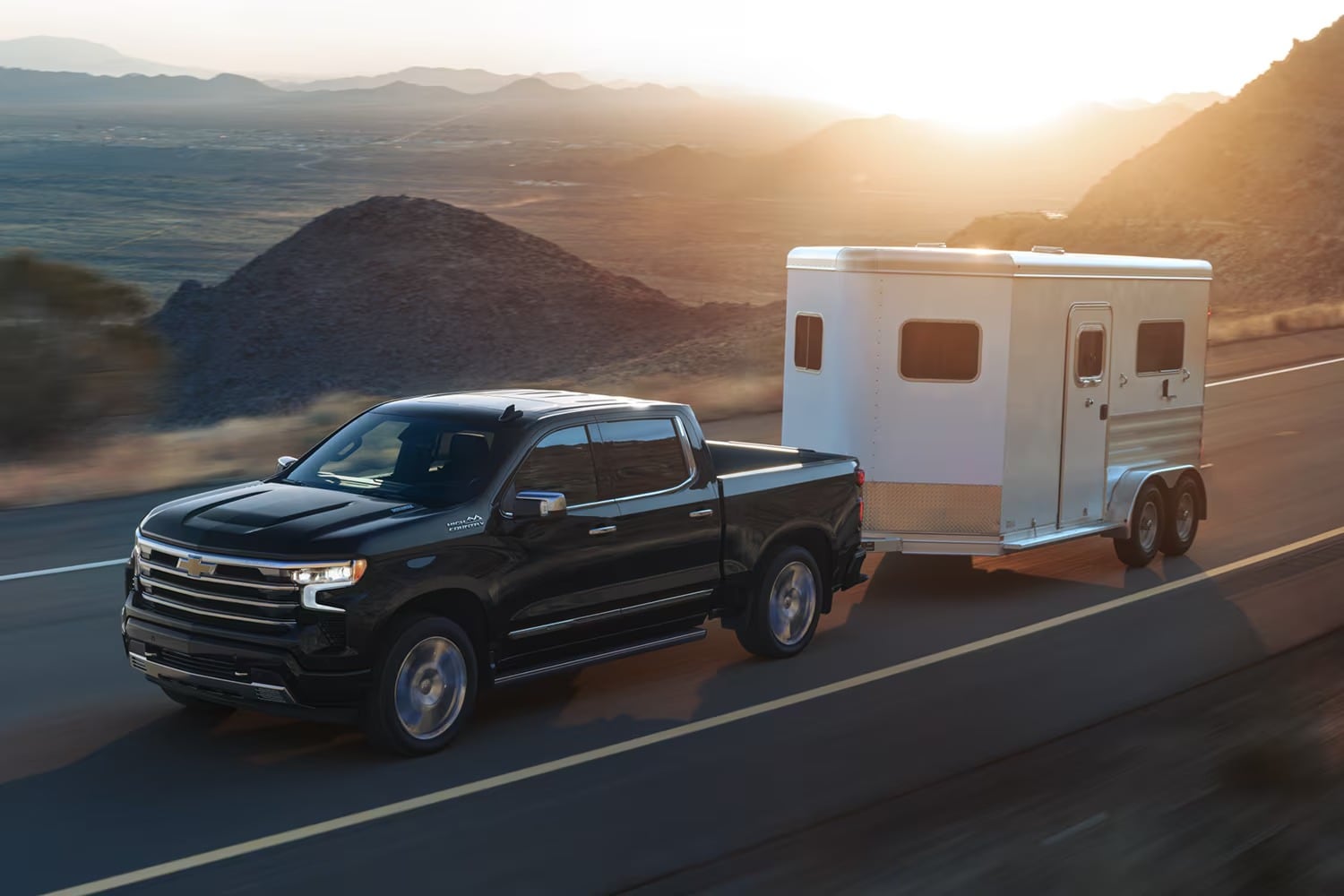
- Payload is the weight your truck carries, while towing capacity is the weight it can pull behind it.
- Tongue weight counts against payload, which is why payload often becomes the real limiting factor.
- Door-jamb ratings matter more than brochure maximums because options, cab style, engine, and drivetrain change the numbers.
Truck shopping should be simple, but two numbers trip up more buyers than almost anything else: payload and towing capacity. Mix them up and you risk overloading a truck you thought could handle the job, or paying for more capability than you actually need. This guide breaks down both metrics across the full 2026 Chevy truck lineup so you can match the right model to what you're actually hauling. If you're ready to browse now, explore our new Chevy truck selection to see what's available.
Payload vs. Towing Capacity: Why So Many Truck Shoppers Get It Wrong
This confusion is incredibly common, and it's not because buyers aren't paying attention. Both numbers show up on spec sheets with little context, and they sound interchangeable when they're really not. Getting this wrong isn't just a performance issue; it's a safety and legal one.
What Payload Capacity Actually Means
Payload capacity is the total weight your truck can safely carry on or in the vehicle itself: passengers, cargo, gear, a toolbox, a gooseneck hitch, anything physically sitting on the truck. The math is straightforward: GVWR minus curb weight equals your usable payload budget.
Tongue weight from any attached trailer also counts against payload. On a bumper-pull setup, expect the tongue to represent roughly 10 to 15 percent of total trailer weight. That means a 6,000-pound trailer adds 600 to 900 pounds to your payload before a single item goes in the bed. The only authoritative source for your specific truck's payload is the door-jamb sticker, also called the Trailering Information Label. Brochure maximums reflect best-case configurations and may not apply to your build.
What Towing Capacity Actually Means
Towing capacity is the maximum weight your truck can safely pull behind it. Engine output, drivetrain, axle ratio, cooling system, and factory towing packages all influence that number. The same base truck can have meaningfully different tow ratings depending on how it's configured, which is why two identically named Silverado 1500s sitting on the same lot can carry different certified numbers.
Why Payload Is Usually the Limiting Factor
You might have a truck rated to tow 13,000 pounds, but if passengers, gear, and tongue weight have nearly consumed your payload budget, you can't safely tow anywhere close to that figure. Towing headlines grab attention in ads. Payload is what limits what you can actually do on a given day.
2026 Chevrolet Payload and Towing Capacity by Model
Here's how the 2026 Chevy truck lineup stacks up. All specs reflect properly equipped configurations. Your specific truck's ratings depend on cab style, drivetrain, engine, and installed options.
| Model | Max Payload | Max Towing (Conventional) | Engine Options | Key Configuration Notes |
|---|---|---|---|---|
| Colorado | 1,690 lbs | 7,700 lbs | 2.7L TurboMax I-4 (310 hp, 430 lb-ft) | Max towing requires Trailering Package; ZR2 and ZR2 Bison rated lower. |
| Silverado 1500 | 2,260 lbs | 13,300 lbs | 2.7L I-4, 5.3L V8, 6.2L V8, 3.0L Duramax | Max towing needs Duramax + Max Trailering Package |
| Silverado 2500HD | 3,979 lbs | 20,000 lbs (conventional) | 6.6L Gas V8, 6.6L Duramax | Crew Cab gooseneck up to 22,430 lbs |
| Silverado 3500HD | 7,290 lbs | 23,300 lbs (36,000 lbs gooseneck) | 6.6L Gas V8, 6.6L Duramax | DRW required for max payload and gooseneck towing |
| Silverado EV | 1,800 lbs | 12,500 lbs | Dual electric motors, AWD | Extended Range LT hits peak figures; Max Range trades capacity for range |
Colorado: Midsize Capability for the Right Buyer
The 2026 Colorado runs a 2.7L Turbocharged I-4 producing 310 hp and 430 lb-ft of torque. Max towing reaches 7,700 pounds when properly equipped, which comfortably covers boats, small campers, and utility trailers. The ZR2 AWD configuration is rated lower at 6,000 pounds, a trade-off for its off-road hardware. Max payload tops out at 2,046 pounds depending on cab, box, and trim.
For weekend adventurers, lighter-duty contractors, or buyers in Victorville and the surrounding High Desert who want genuine truck utility without full-size bulk, the Colorado makes a lot of sense.
Silverado 1500: Half-Ton Capability Across Configurations
The 2026 Silverado 1500 offers the broadest range of engine choices in the lineup. The 2.7L Turbo I-4 typically delivers the highest payload thanks to its lighter weight. The 5.3L V8 balances payload and towing well. The 6.2L V8 targets maximum towing performance. The 3.0L Duramax Diesel rounds things out with efficiency and strong low-end torque.
Max towing reaches 13,300 pounds, but only when the truck is spec'd with the Max Trailering Package and a Crew Cab Short Bed 2WD setup with the 3.0L Duramax Diesel. Max payload peaks at 2,260 pounds in specific configurations. The ZR2 trim towing ratings vary by engine: the 6.2L V8 ZR2 is rated at 8,800 lbs towing and the Duramax 3.0L I-6 ZR2 is rated at 8,700 lbs towing in Crew Cab Short Bed 4x4 configuration. Always verify your door-jamb sticker. If you're weighing configurations or want to understand financing for a specific build, explore our financing options before you commit.
Silverado 2500HD: When Half-Ton Isn't Enough
The 2026 Silverado 2500HD is built for sustained heavy use. The 6.6L Duramax Turbo-Diesel V8 is required to reach the highest conventional towing ratings, along with the correct axle ratio and Max Trailering Package. The 2026 Silverado 2500HD with the Duramax and Max Trailering Package reaches up to 20,000 lbs of conventional towing in Crew Cab and Double Cab configurations. Even the minimum ball hitch configuration starts at 14,500 pounds of towing in Regular Cab Long Bed and Double Cab Standard Bed setups. Max payload reaches 3,689 pounds depending on cab, bed, and drivetrain.
For regional construction, landscaping dump trailers, larger horse trailers, and commercial work where the 1500 comes up short, the 2500HD is the right fit. With up to 20,000 pounds of conventional towing capacity when properly equipped with the Duramax diesel and Max Trailering Package, it handles demands that exceed the 1500's capabilities. It handles High Desert terrain and highway loads without the payload limitations that push half-ton owners toward compromises.
Silverado 3500HD: Maximum Payload and Towing for Serious Work
The 2026 Silverado 3500HD reaches 36,000 pounds of towing capacity in fifth-wheel or gooseneck configurations when properly equipped with the Duramax diesel. That figure doesn't apply to conventional ball hitch setups. Max payload in Dual Rear Wheel (DRW) configurations reaches 7,324 pounds. Single Rear Wheel (SRW) gasoline 4WD Regular Cab configurations deliver up to 4,590 pounds of payload, while DRW 2WD gasoline configurations reach up to 7,290 pounds.
Hauling large fifth-wheel RVs, horse trailers, or heavy equipment for commercial fleet use? The 3500HD is purpose-built for exactly that. It sits at the top of the Chevrolet capability range for good reason.
Silverado EV: Electric Capability With Real-World Range
The 2026 Silverado EV runs dual electric motors with AWD standard across all trims. In Wide Open Watts mode, it delivers 760 hp and 775 lb-ft of torque, hitting 0 to 60 in 4.6 seconds. Payload and towing numbers vary by range tier:
- Standard Range (WT 4WT / LT 2LT): 2,350 lbs payload, 8,500 lbs towing
- Extended Range (WT 5WT / LT 3LT): 1,800 lbs payload, 12,500 lbs towing
- Max Range WT 8WT: 1,400 lbs payload, 7,500 to 10,500 lbs towing
- Max Range LT 4LT: 1,000 lbs payload, 7,500 to 10,500 lbs towing
Plan for roughly a 50% range reduction when towing near max capacity. With a starting range of up to 440 miles, the EV still provides meaningful towing range for regional use. StabiliTrak with trailer sway control and hill-start assist come standard across all trims.
How Trim, Cab Style, and Options Shift Your Numbers
The advertised maximum for any model rarely applies to every configuration. Several factors move those numbers:
- Engine choice (the 2.7L Turbo I-4 often yields higher payload on the 1500 due to lower curb weight)
- Cab style (Crew Cab adds weight, reducing payload budget vs. Regular Cab)
- Drivetrain (2WD often enables higher tow and payload ratings than 4WD)
- Bed length
- The Max Trailering Package, which is required to achieve max towing on the Silverado 1500 and 2500HD
The door-jamb sticker is the definitive number for your specific truck. For additional confirmation, our service team can verify ratings for any vehicle in your driveway or on our lot.
Matching the Right Chevy Truck to Your Actual Use Case
Buyers in Victorville and the High Desert often need trucks that handle both highway loads and varied terrain. Here's how real-world use maps to each model:
- Light recreational use, a boat, camping trailer, or weekend gear: Colorado
- Family RV or 26-foot travel trailer heading toward the mountains or a lake: Silverado 1500, properly equipped
- Regional construction or landscaping dump trailer: Silverado 2500HD
- Horse trailer, large fifth-wheel RV, or commercial fleet: Silverado 3500HD DRW
- Eco-conscious hauler or tech-forward buyer with lighter towing needs: Silverado EV
Start with your typical loaded scenario, not some edge case you'll encounter twice a year. Count your regular passengers, factor in tongue weight, and choose the model with a payload budget that handles your real day with room to spare.
Chevrolet Payload and Towing FAQ
Frequently Asked Questions
What is the difference between payload and towing capacity?
Payload is the total weight your truck carries on or in it, including passengers, cargo, and tongue weight from any attached trailer. Towing capacity is the maximum weight the truck can pull behind it. Both are separate limits and both must be respected at the same time.
Why does my Silverado's actual payload differ from the brochure maximum?
Brochure maximums reflect the best possible configuration for that model. Your truck's cab style, engine, axle ratio, drivetrain, and installed options all determine your certified number. The door-jamb sticker is the only authoritative source for your specific build.
Does 4WD reduce towing or payload capacity?
Often, yes. 4WD adds drivetrain weight, which lowers payload. For towing, 2WD configurations frequently unlock higher ratings than equivalent 4WD setups. That's why max towing figures on the Silverado 1500 apply to Crew Cab 2WD builds.
Do I need the Max Trailering Package to reach maximum towing?
Yes, on the Silverado 1500 and Silverado 2500HD. The package upgrades the hitch, cooling system, and wiring and is required to hit the published max towing figures for both models.
How does tongue weight affect my payload?
Tongue weight counts directly against your payload budget. On a bumper-pull trailer, plan for 10 to 15 percent of total trailer weight transferring to the truck. A 6,000-pound trailer adds 600 to 900 pounds to your payload load before any additional cargo or passengers are counted.
Get a Tow and Payload Fit Check at Victorville Chevrolet
Spec sheets only go so far. Matching capability numbers to your actual trailer, load habits, and daily use takes a real conversation.
Work Through It With Our Team
At Victorville Chevrolet, we work through those specifics with you rather than handing you a brochure. Whether you're comparing a Silverado 1500 against a 2500HD, sorting through trailering packages, or confirming what a specific build's certified payload looks like for your work trailer, our staff can help you confirm the right setup before you buy. We also handle custom factory orders for buyers who need a specific configuration.
Schedule Your Fit Check
Real-world configurations need to be confirmed in person, not estimated from brochures. Contact Victorville Chevrolet to schedule a tow and payload fit check or to ask questions about current inventory and available builds. We're here to make sure the truck you choose actually fits the job.
Categories:
Towing