



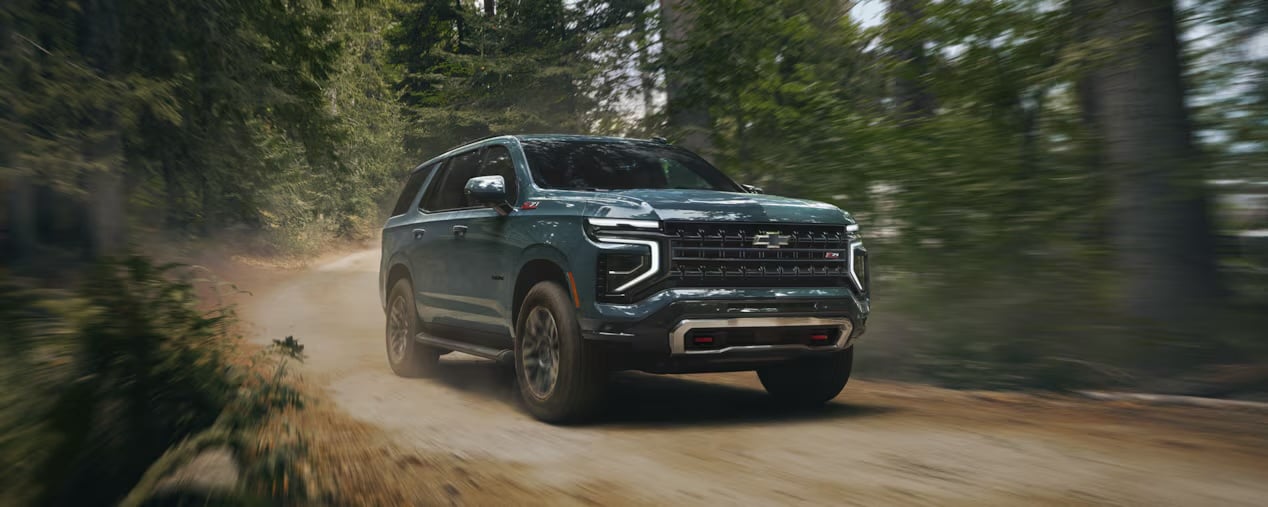
When High Desert families start cross-shopping full-size SUVs, the 2026 Chevy Tahoe vs 2026 Toyota Sequoia debate comes up fast. Both promise room for the whole crew and enough muscle to tow a boat to Silverwood Lake, plus the kind of daily comfort that makes I-15 commutes tolerable. Once you look past the marketing copy, though, the two SUVs live pretty differently day to day.
We've spent plenty of time with the Tahoe on our lot in Victorville, and we'll walk you through where each one earns its keep. If you want to see the lineup for yourself, our new Tahoe inventory is a good place to start.
2026 Tahoe vs 2026 Sequoia: Which Full-Size SUV Fits High Desert Life?
If you're wondering whether a Toyota Sequoia is bigger than a Tahoe, the short answer is no. When people search for the Toyota equivalent to Tahoe, they usually land on the Sequoia, and it's a fair comparison on paper. Both are body-on-frame SUVs built to haul families, gear, and trailers.
But Tahoe vs Sequoia size comparisons favor Chevy almost across the board, cargo volume and third-row legroom included. The Tahoe also offers three distinct powertrains, including a diesel with serious highway range, while the Sequoia sticks to one hybrid setup. For desert driving, towing trips to the Mojave River, and long hauls on I-15, those differences add up quickly.
Comfort and Cabin Space for Victorville Families
Seating, Third-Row Legroom, and Cargo Room
Space is where the size question gets settled fastest. The Tahoe seats up to eight, or nine if you opt for the front bench on the LS trim, and its third row offers 34.9 inches of legroom, enough to make a real difference for teenagers or adults on longer drives. The Sequoia seats up to eight as well, or seven with captain's chairs, but its third row comes in at 33.7 inches, tight for anyone over six feet.
Cargo capacity is where the Tahoe pulls ahead most decisively. Its 122.7 cubic feet of maximum cargo room towers over the Sequoia's 86.9 cubic feet, a roughly 41% advantage. In practical terms, that means loading a full set of camping gear for a Mojave Narrows weekend without playing Tetris or strapping anything to a roof rack. The Tahoe's second and third rows fold flat for a level load floor, ideal for bikes, furniture, or anything bulky, while the Sequoia's third row doesn't fold into the floor thanks to its hybrid battery pack. When the job is hauling more than just soft bags, the Tahoe gives you the flat, usable space to do it.
Interior Materials and Everyday Livability
Beyond the numbers, day-to-day livability counts. The Tahoe's cabin uses materials that hold up to sun exposure and daily wear, something High Desert owners notice after a few summers of triple-digit heat. The second row also slides up to 5.5 inches, giving families flexibility to prioritize third-row access or legroom depending on who's riding. The Sequoia's interior is well built too, but the Tahoe's layout feels more tailored to families who need to reconfigure space often rather than set it once and leave it.
Capability and Towing Confidence on I-15 and Beyond
Towing Capacity for Trailers, Toys, and Weekend Trips
The Sequoia's towing capacity tops out at 9,500 pounds, ahead of the Tahoe's 8,400 pounds when equipped with the 5.3L V8 and Max Trailering Package. If your weekend routine involves a heavier travel trailer, that extra 1,100 pounds of capacity is worth acknowledging honestly.
For boats, ATVs, and mid-size trailers headed to Silverwood Lake or the Mojave River, though, the Tahoe's 8,400-pound rating covers the vast majority of what High Desert families actually tow. Where the Tahoe pulls ahead is flexibility. General Motors offers three distinct engine choices, so buyers can match the powertrain to their towing habits rather than settle for one hybrid setup that has to do everything.
If you're financing a Tahoe built for regular towing duty, our team can walk you through financing options that fit the trim and powertrain you need.
Powertrain Performance in Desert Heat
The Tahoe's base 5.3L EcoTec3 V8 makes 355 hp and 383 lb-ft, with a 6.2L V8 available at 420 hp and 460 lb-ft for buyers who want more muscle. The standout for desert road trips, though, is the Duramax 3.0L Turbo-Diesel, delivering 305 hp, 495 lb-ft of torque, and a max highway range of 624 miles. That kind of range means fewer stops on long hauls out of Victorville, which matters when the nearest station might be well down the highway.
The Sequoia counters with its i-FORCE MAX 3.4L twin-turbo V6 hybrid, putting out 437 hp and 583 lb-ft of torque, genuinely strong numbers that beat the Tahoe's base engine on paper. It's also the more fuel-efficient option, rated at 21/24/22 MPG in RWD form compared to the Tahoe's 15/20/17 MPG with the base V8. Toyota's hybrid system has a solid reputation for reliability, and we won't pretend otherwise.
Still, the Tahoe's lineup gives desert drivers more ways to match power and efficiency to their specific needs, whether that's the six-cylinder diesel's range or the 6.2L's raw output, rather than leaning on one hybrid setup for every scenario.
Technology and Everyday Usability
Infotainment and Connectivity Features
The Tahoe's cabin centers around a 17.7-inch touchscreen with Google built-in, paired with an 11-inch driver display and wireless Apple CarPlay and Android Auto as standard equipment. That's a notably larger screen than the Sequoia's standard 8-inch touchscreen, and even the available 14-inch upgrade on higher Sequoia trims doesn't match it, a difference that's obvious the moment you're navigating or splitting the screen between apps. Available extras like a 15-inch head-up display push the Tahoe's tech further ahead for buyers who want it.
Driver-Assist Tech for Daily Commutes
Both SUVs come with solid safety suites, Chevrolet Safety Assist on the Tahoe and Toyota Safety Sense 2.5 on the Sequoia. The Tahoe offers something Toyota doesn't, though: Super Cruise, available on LT, RST, Premier, and High Country trims, giving hands-free driving on compatible highways.
That's a genuine plus for anyone logging long stretches of I-15 on a regular basis. The Tahoe also offers up to 14 camera views for maneuvering in tight parking lots or trailer hookups, adding a layer of confidence the Sequoia's setup doesn't quite match.
Sequoia's Strengths: Where It Stands Out
We think it's worth being straight about where the Sequoia genuinely shines. Its standard hybrid powertrain delivers strong torque and better fuel economy across the board, appealing to buyers who want efficiency without downsizing. Its 9,500-pound max towing rating beats the Tahoe's, which matters for owners with heavier trailers.
The TRD Pro trim adds FOX shocks and a skid plate, rides on 33-inch tires, and offers 9.1 inches of ground clearance, making it a legitimate option for buyers focused on off-road capability. If fuel economy and torque are your top priorities, the Sequoia is a Toyota Sequoia alternative worth cross-shopping, and we'd rather you know the full picture than hear only one side.
Why the Tahoe Wins for Victorville-Area Families
For most High Desert families, the Tahoe is the more practical everyday choice. It has 122.7 cubic feet of cargo room versus 86.9, flat-folding second and third rows versus a Sequoia third row that folds but not as flush, and three powertrain choices versus one. Add in Super Cruise, a larger touchscreen, longer third-row legroom at 34.9 inches, and a higher max payload of 1,834 pounds compared to the Sequoia's 1,730 pounds, and the Tahoe simply covers more bases for families juggling school runs one day and camping trips the next.
There's also the ownership side of the equation. Buying a Tahoe from us means access to our certified service center and genuine OEM Chevrolet parts, something Toyota shoppers in the High Desert don't get locally through our dealership. Whether it's routine maintenance or diesel-specific service down the road, having factory-trained technicians nearby carries real value over the life of the vehicle.
Explore Tahoe Inventory at Victorville Chevrolet
Whether you're weighing a Chevy Tahoe or Toyota Sequoia for family duty or towing trips around the High Desert, the specs make a strong case for the Tahoe.
Come see the lineup in person and browse our current inventory of Tahoe models to find the trim and powertrain that fits your driving. Contact our team to schedule a test drive today.
Frequently Asked Questions About the 2026 Chevy Tahoe vs Toyota Sequoia
Is the 2026 Toyota Sequoia bigger than the Chevy Tahoe?
No. The 2026 Chevy Tahoe provides more maximum cargo space and slightly more third-row legroom than the 2026 Toyota Sequoia. The Tahoe offers 122.7 cubic feet of maximum cargo volume, compared to 86.9 cubic feet in the Sequoia.
Which can tow more: the 2026 Tahoe or Sequoia?
The 2026 Toyota Sequoia has the higher maximum towing capacity at up to 9,500 pounds. The 2026 Chevy Tahoe can tow up to 8,400 pounds when equipped with the 5.3L V8, rear-wheel drive, and Max Trailering Package.
Does the 2026 Tahoe or Sequoia have better fuel economy?
The 2026 Toyota Sequoia offers better fuel economy with its standard hybrid powertrain. However, the Tahoe provides three engine options, including a Duramax 3.0L Turbo-Diesel designed to deliver strong torque and extended highway range.
Does the 2026 Chevy Tahoe offer Super Cruise?
Yes. Super Cruise hands-free driver-assistance technology is available on the 2026 Chevy Tahoe LT, RST, Premier, and High Country trims for use on compatible roads.
Categories:
Model Comparison